
Author: Kirsi Peltonen
Department of Mathematics and Systems Analysis, Aalto University
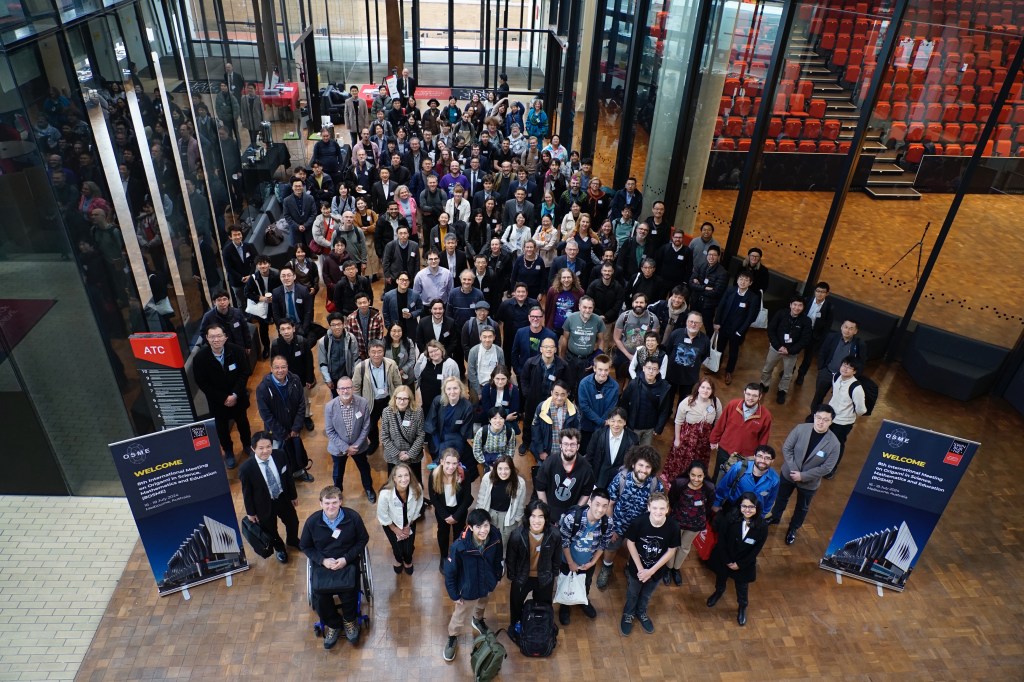
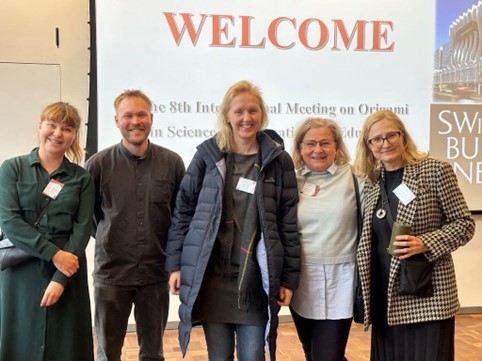
The 8th International Meeting on Origami in Science, Mathematics and Education (8OSME, http://www.impactengineering.org/8OSME/) was held at Swinburne University of Technology in Melbourne, Australia from July 16-18, 2024 and followed by the Folding Australia 2024 origami convention on 20-21 July. Fold2 project team Markus Holste (Aalto), Miia Palmu (VTT) and Kirsi Peltonen (Aalto) contributed to the conference with two talks delivered by Markus and Miia. The presentations were based on collaboration related to the Fold project by M. Holste, K. Peltonen, M. Dias and L. de Waal: ‘Kirigami-inspired rectangular iso-area twist tessellations in architecture’ and M. Palmu, K. Peltonen, M. Dias, L. de Waal and T. Kankkunen: ‘Design of morphing and multifunctional shape profiles through cutting tessellations’.
8OSME was the 8th conference in a series dedicated to research in the applications of origami and folding in the conference title fields, as well as in technology, design and history. The preceding seven conferences have been organized in Ferrera, Italy (1989), Otsu, Japan (1994), Pacific Grove, California, USA (2001), Pasadena, California, USA (2006), Singapore (2010), Tokyo, Japan (2014) and Oxford, UK (2018). From the first 17 talk event 1OST (The First International Meeting of Origami Science and Technology) has grown to a meeting of 127 full papers to appear in 8OSME Proceedings of four volumes. Six plenary talks by Darryl Bedford (UK), Yan Chen (China), David Eppstein (Canada), Tomoko Fuse (Japan), Glaucio H. Paulino (USA), Zhong You (UK) were followed by four parallel sessions: two in Engineering, one in Mathematics, Computation and History and one in Design and Education.
The truly interdisciplinary nature of the conference was reflected in the presentations, where for example our designers could fluently give talks in the engineering session devoted to kirigami. The word ‘kiri-origami’ seemed to be broadly adapted in context of folded structures where different types of cuts are added. The goal of adding cuts is to change the behaviour of the tessellation pattern. In Miia’s presentation this was demonstrated by deforming a standard Miura-ori pattern with one degree of freedom to a highly flexible shape via suitable cuts. The design was found after numerous systematic qualitative experiments and the structural properties were then verified via quantitative simulations. Interestingly, a closely related pattern was discovered independently by Zhong You via computational means. Connections of these approaches and phenomena related to thick origami, will be studied further later in the fall in the Fold project in collaboration with You and his team, when Miia and Jukka Ketoja (VTT) will make a research exchange visit to University of Oxford.
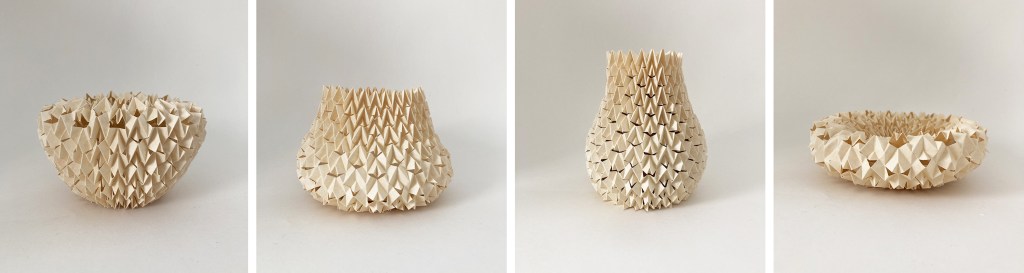
Markus presented his design studies related to the so called Momotani Brick Wall pattern. The idea here is to remove overlapping square twist parts from the tessellation to achieve possibilities for industrial production in different scales and controlled flexibility for various one or several layer application solutions. This research continues in the Fold project in collaboration with Marcelo Dias and Leo de Waal at The University of Edinburgh.

Several samples from the Fold project were also showcased during the conference. We gained a lot of attention and interest from other participants. World-renowned origami artist Tomoko Fuse was also playing with the samples from the Fold project. In addition to her plenary talk ‘Infinite Fold and Repeated Fold’ at the conference she also gave two ‘Secret Workshops with Tomoko Fuse’ in the following Folding Australia 2024 convention. Her work was showcased at the exhibition ‘Future Folds: Contemporary Investigations in Origami’ opened after the conference at Design Hub Gallery of RMIT (The Royal Melbourne Institute of Technology). The exhibition was curated by Sukanya Deshmukh and Malte Wagenfeld from pieces by Robert J. Lang, Jun Mitani, Koya Narumi, Tomohiro Tachi and others.

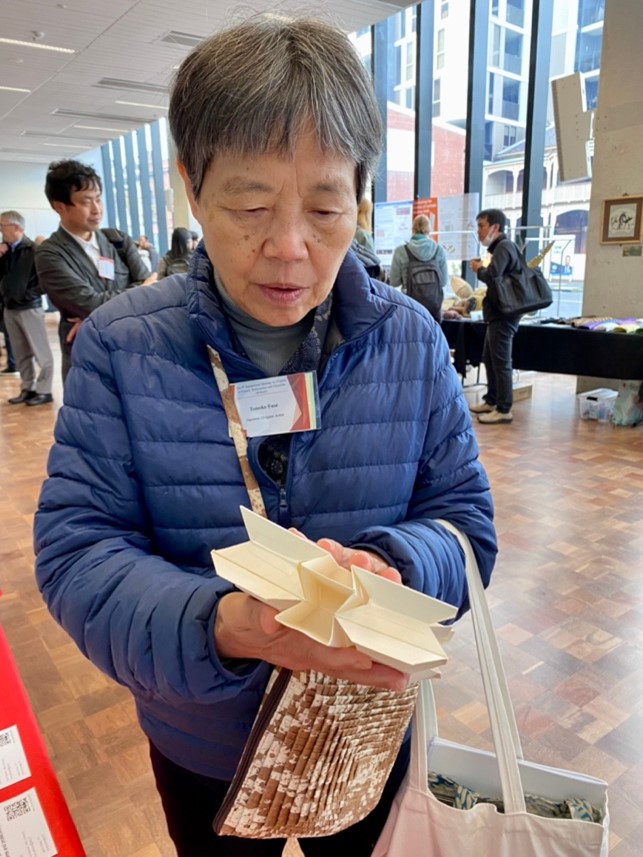
Origami artist Tomoko Fuse studying a machinery folded sample made from 170gsm Cupforma NaturaTM cardboard provided by Stora Enso.
Tomoko Fuse testing auxetic properties of a sample made by Markus.
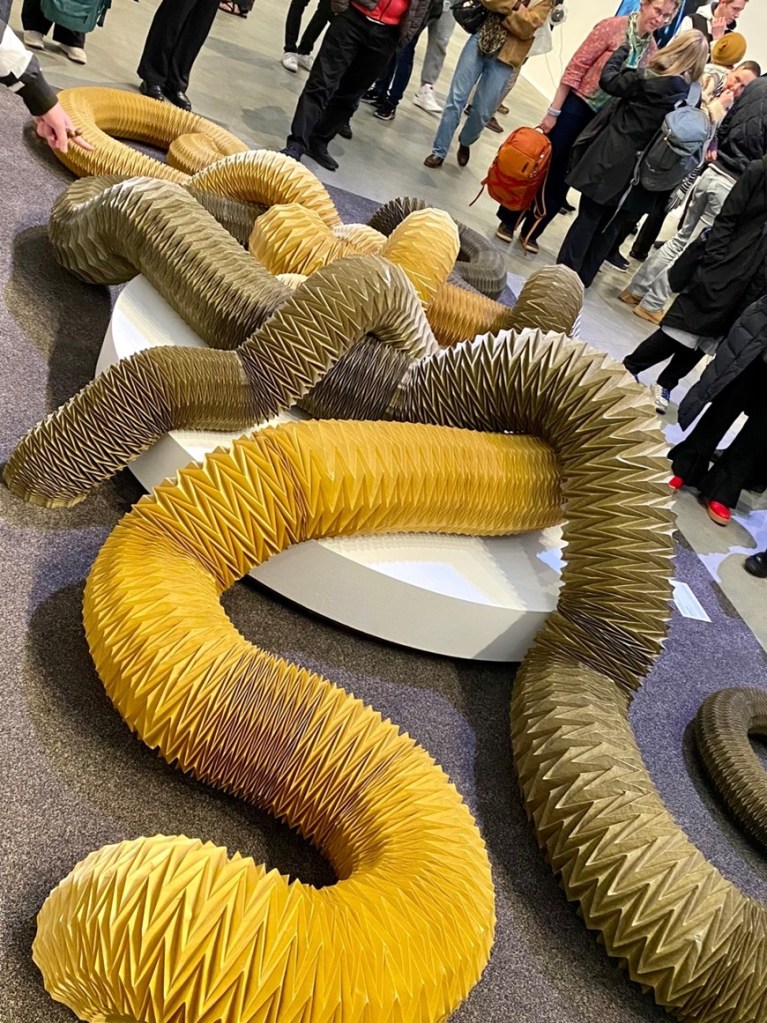
‘Orochi´ by Tomoko Fuse at the ‘Future Folds: Contemporary Investigations in Origami’ exhibition.
An extensive contribution for the conference was given by Tomohiro Tachi (https://origami.c.u-tokyo.ac.jp/) and his team. He was influential to at least ten presentations and demonstrations directly and many more through his groundbreaking work in the field. He has been highly influential broadly, covering areas like computational origami, self-assembly and self-folding, origami engineering, polyhedral tessellation, cellular material, structural morphology, deployable structures, kinematic design and computational fabrication. I will visit the Tachi Lab in Tokyo later this fall.
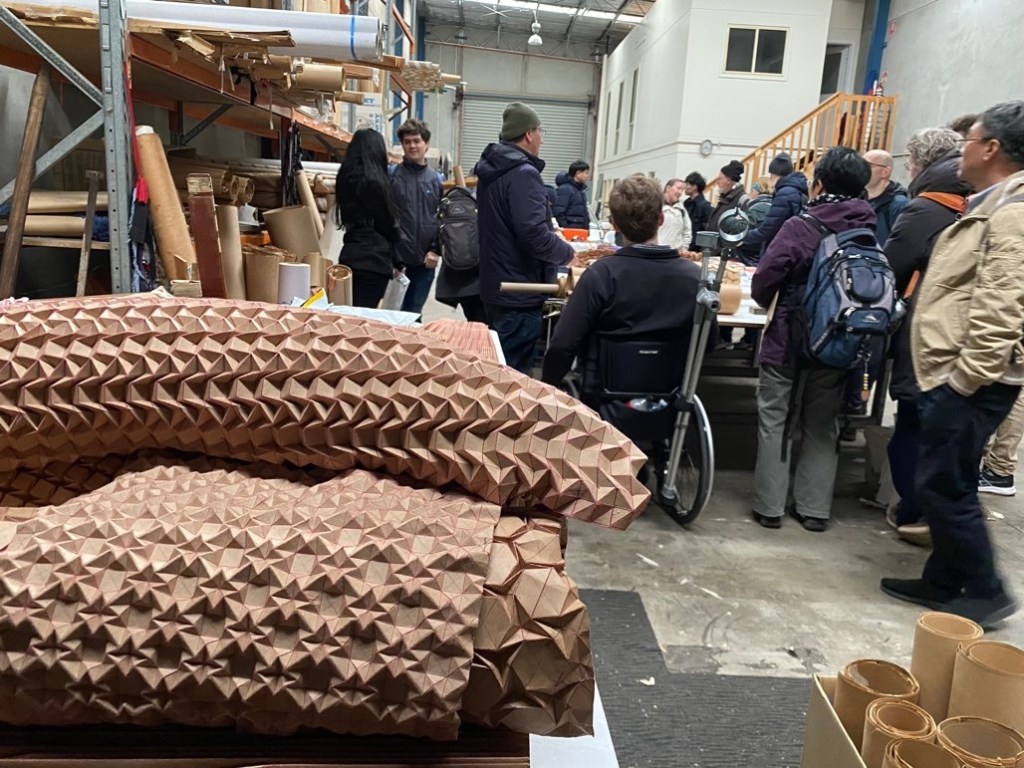
After the conference I participated a morning walk to local paper shops organized by the president of Melbourne Origami Group Michael Assis from the University of Melbourne. This was an excellent opportunity to find interesting materials for the Fold project for experimentation. In the afternoon we were guided by Michael and origami artist Winnie Leung for a visit at company Specialty Pleaters that is a fabric pleating factory. It was amazing to see the huge variety of patterns that can be produced and learn more about the fine details of this almost-extinct art form.
A two days Folding Australia 2024 workshop was arranged during the weekend after the conference. Unfortunately, I was able to attend only for the program of the first day. I was more than happy to successfully finish the model by origami creator Peter Whitehouse whose model was ranked to the level ‘intermediate’. Our Estonian colleague Anne Rudanovski was witnessing my successful performance. During the folding session by Joseph Wu, I found my limits. His model was a beautiful Tessellation Cat that was ranked to level ‘High Intermediate’. To my big disappointment, I dropped at some point and could not follow to the end although I was provided generous help from a high school student sitting next to me and I was sitting behind origami masters Tomoko Fuse, Robert J. Lang and Madonna Yoder showing the way. Luckily Joseph promised a link to a video for this model that I could follow as slowly as needed. A slight comfort was provided by Robert as he said that he would rank this model to level ‘complex’.
 Fold Project